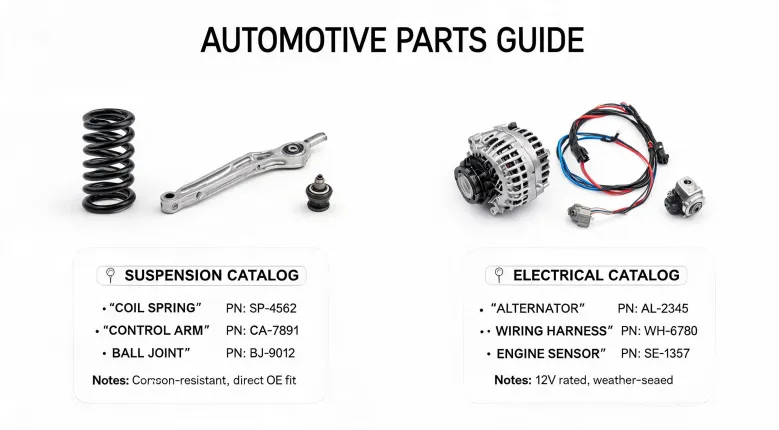
It looked perfect. It was still wrong.
Picture this: forty Mando ABS wheel speed sensors in a white box. Every single one clicks into the connector, the cable length matches, and the packaging says 'Mando.' But the ECU doesn't see a signal. I know why now. I didn't then.
I'm a purchasing coordinator handling aftermarket automotive and marine parts orders for nine years. I've personally made—and documented—14 significant mistakes, totaling roughly $11,000. Maybe $11,400, I'd have to check. Now I maintain our team's pre-order checklist. That sensor order in September 2022 was one of the worst. It looked fine on my screen. The result was forty parts, roughly $1,900, and a two-week delay for a customer who didn't have a car to drive. I keep the failed part on my desk as a reminder.
If you've ever had a replacement part arrive and not work, you know the feeling. But the real problem isn't usually the part. The problem is the spec.
The surface problem: 'it says Mando ABS wheel speed sensor'
When I searched for a 'Mando ABS wheel speed sensor,' I thought that was a part. It's not. It's a category. There are dozens of variants: different connectors, mounting flanges, cable lengths, output types, tone-ring tooth counts. A sensor for one model can look identical to another and still produce a signal the ECU can't read.
On a vehicle, even the same sensor can serve different wheel positions. Left and right are often the same—but not always. Front and rear can have different cable lengths. Some systems use active sensors powered by the ECU; others use passive magnetic sensors. Mix them up and the ABS module may log a fault code or simply ignore the signal.
That's the moment most people blame the brand or the supplier. In my case, Mando wasn't at fault. Basically, I ordered by name, not by part number.
The deeper cause: part numbers are specifications, not labels
The real problem is that we treat compatibility as a single checkbox. It's actually a web. Consider the same model year on a Honda: a 2008 CRV catalytic converter can be different depending on the emissions calibration, the engine variant, and the production month. Nobody would call every 2008 CRV catalytic converter identical. Yet we do this with sensors and alternators all the time.
The same pattern shows up outside the workshop. I once ordered a baseboard radiator for my own house by the brand and approximate length. The valve spacing was off by half an inch. My fault, not the radiator's. The picture was right; the spec sheet was where the truth lived.
And when people ask about a choice like 'cobra ball vs rivet joint' in a stamped assembly, they're usually looking for one correct answer. But the answer depends on load direction, material thickness, corrosion environment, and whether the joint will ever need to come apart. The question isn't 'which is better?' The question is 'under what conditions?'
That's why I now cringe at the phrase 'OEM equivalent.' Per FTC guidelines (ftc.gov), advertising claims need to be truthful and not misleading. But even a substantiated claim like 'fits the same application' doesn't cover every bolt hole, pulley offset, or voltage regulator calibration. A Mando marine alternator is a perfect example: the mounting bracket can be right, but if the pulley size or regulator type doesn't match your engine, it's not the right part.
According to FTC guidelines (ftc.gov), claims have to be truthful, not misleading, and backed by evidence. That applies to 'OEM equivalent' and 'direct fit' claims. It doesn't mean every claim with a disclaimer is false; it means the claim alone isn't a spec.
What it really costs
The first mistake cost more than the part price. Let's do the math:
- Part cost: $1,900 for forty sensors.
- My time verifying and return handling: about 10 hours.
- A week of downtime for the customer: impossible to put a dollar sign on.
- The next rush-order surcharge: whatever the supplier decided to charge, and it felt like a punishment.
There's also the second-order cost: team trust. After that order, everyone second-guessed the sensor listing. The real problem was my specification. On a later 120-piece order, I caught the same issue before production. That one would have been $3,200 plus an even bigger delay. We've avoided 47 potential errors with the checklist I built after the third rejection in Q1 2024.
The checklist that stopped the bleeding
I don't believe in perfect processes. But this one works. Before you place an order for anything—especially small-batch replacement parts—do this:
- Find the OEM part number on the old part or the vehicle. The brand name alone is not enough.
- Measure the physical envelope: length, connector, mounting holes, cable route. Write them down.
- Ask for a dimensional report or a test photo. Honest suppliers are happy to show the flange and connector before you pay.
- If you're buying a 'compatible' part, ask what was actually validated. 'OEM equivalent' without data is a red flag.
- Order one or five pieces first. A small order is not a hassle; it's an insurance policy. The suppliers who treat small orders seriously are the ones I trust with bigger ones later.
Bottom line
The lesson wasn't 'Mando parts are bad' or 'aftermarket parts are risky.' It was that I was treating a replacement part like a commodity when it's actually an engineered component. Once I started comparing specs and asking questions, the failure rate dropped.
Honestly, I'm not sure why it took me three rejections to learn that. But if you're about to order a Mando ABS wheel speed sensor—or a Mando marine alternator, a 2008 CRV catalytic converter, or even a baseboard radiator for your own house—spend the five extra minutes on the part number. You'll save more than money.