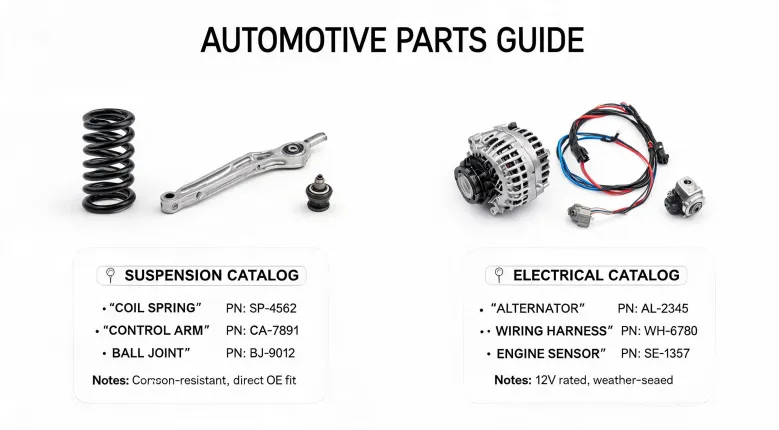
I hear some version of this every time I talk to a shop owner: “Where can I find Mando steering systems?” I understand why people want one clean answer. I manage parts buying for a 45-person fleet maintenance operation, and I have tracked every parts invoice for the past six years. My cost spreadsheet includes freight, cores, return risk, and install labor, not just the price line.
The better question is: which buying situation are you in? A Mando steering system, a Mando disc brake caliper, a rear strut assembly, H9 headlight bulbs, and a leaf spring all sound like auto parts. They are not the same kind of purchase.
Start Here: Four Buying Situations
- Situation 1: OE-critical steering and braking parts. When a late-model vehicle needs to steer and stop correctly, I want traceability and a Mando part number before I want the best price.
- Situation 2: VIN-specific suspension parts. A rear strut assembly can look the same across trim levels, but spring rate, ride height, and mounting style can be different.
- Situation 3: Standardized consumables like H9 headlight bulbs. The bulb code and housing approval matter more than the name on the box.
- Situation 4: Dimension-driven parts such as leaf springs. When the original part number is gone, the measurement is the part number.
The mistake is using the same sourcing process for all four. Let me walk through how I actually buy each one.
Where Can I Find Mando Steering Systems?
The first place to look is the Mando part number, not a website. A steering unit can look identical across several model years and still be different: connectors, damping, sensor calibration, even the casting revision can change. If you buy by year range alone, you might get a part that bolts on but does not behave the same when the wheel is turned.
Start with the VIN and find the OE part number in a factory catalog or dealer parts system. If the correct replacement is a Mando unit, ask the seller to write the Mando part number on the quote. For a current fleet vehicle or a customer car, I start with a franchised dealer or a distributor that can confirm it has an authorized Mando source. It is not usually the cheapest quote, but it gives me a paper trail.
One listed “OE” steering unit came in about $200 lower than the next quote. The seller would not confirm a Mando part number. The photo showed a different electrical connector when zoomed in. To me, that was not a $200 saving; that was a restocking fee waiting to happen. Per FTC advertising guidance, claims like “genuine” or “OE” need to be truthful and substantiated. The Mando part number is the substantiation.
Mando Disc Brake Caliper: Don’t Stop at the Quote
A Mando disc brake caliper is still safety-critical, but it is more replaceable than a steering system. A remanufactured caliper can be a smart buy if you can manage the core return. The problem is that people compare the first price and ignore the process.
I compare caliper quotes with four questions: What is not included? Is the bracket included or are guide pins and clips extra? Is there a core charge and who pays return freight? And what happens if the caliper is defective—will the replacement be sent before the old one is returned?
I once compared a reman caliper at roughly $70 with a new Mando disc brake caliper at $105. The reman had a $40 core charge and the new part did not. Add return freight and a missing bracket kit, and the reman only made sense if the core actually went back. If we missed the core return window, the reman became the expensive option. (Don’t quote me on the exact numbers; the structure is the part I remember.) A vendor that lists all those fees on the first quote is not being difficult. It is giving me the real total.
Rear Strut Assembly: The “Complete” Trap
The term rear strut assembly sounds like everything is included. Sometimes it is. But complete can mean the coil spring is already assembled to the strut; it does not automatically mean the top mount, bump stop, or boot are included. Two quotes can look similar and contain very different boxes.
For a one-car repair, I often recommend a full rear strut assembly because the labor savings and safety make it worth the money. In our shop, the math can flip. If the original upper mount is still good and we already have a spring compressor, buying a bare strut and reusing the mount may cost less without adding much time. The blanket advice that a complete assembly is always better ignores that some shops are set up to do the swap quickly.
Whichever route you take, use the VIN, not just the model year. A rear strut assembly can be side-specific, and the same vehicle can have different rear suspension packages depending on trim. The supplier’s catalog should be able to show a part number that matches the VIN. If it only matches make and model, keep asking.
H9 Headlight Bulbs: The Category That Needs a Different Rule
H9 headlight bulbs belong in a different buying category. They are still important, but the source decision does not have the same risk profile as steering or brakes. Start with the bulb code, not the vehicle model. If the old bulb and the housing both say H9, buy an H9. If a listing says “H9/H11 compatible,” slow down. Physical connector compatibility is not the same as correct wattage and beam pattern.
For a part like this, I do not need an OE part number, but I do need the supplier to state the bulb type and wattage clearly. A cheap H9 that fails six weeks later is not a $15 problem if the vehicle bumper has to be partially removed to reach the bulb; in that case, the labor cost becomes part of the TCO. Keep a spare or two, but do not stock a mystery brand just because the price is lower.
How Do You Measure a Leaf Spring?
If you are searching “how do you measure a leaf spring?”, the original part number is probably gone. That is fine; the spring itself gives you the clues.
Lay the spring on a flat surface with no load on it. Measure the center-to-center distance between the front and rear eyes first. This is the spring length. Do not follow the curve with a tape measure; that gives you the steel length, and it will be longer than the spring’s effective length. Next, place a straight edge across the eye centers and measure the arch at the center bolt. Write down the main leaf width, the inside diameter of the eyes/bushings, the number of leaves, and the total stack thickness. A photo of the spring next to a tape measure also helps the supplier.
If the spring is broken or settled, the measurements may not match a catalog. That is useful information too. It tells the supplier you need actual dimensions, not a guess based on vehicle age.
Which Scenario Are You In?
If you still want a simple step, use this one. For steering and brake parts, treat the part as safety-critical until you can prove otherwise. Check the VIN, get the Mando part number, and add every fee before you compare. For a rear strut assembly, check the included parts and suspension package. For H9 headlight bulbs, check the bulb code and housing. For a leaf spring, measure first.
The old rule always get three quotes is useful, but I do not apply it to everything. Comparing three quotes for a bulb can cost more time than the bulb is worth. Comparing three quotes for a Mando steering system is cheap insurance. The right answer depends on the failure risk, the part number, and the cost of a wrong guess. Once you know those three things, the best source becomes much easier to find.
Where can I find Mando steering systems? Start with the Mando part number. Then choose the supplier whose total cost, return policy, and paper trail fit the vehicle you are working on. That is the answer that holds up after the invoice is paid.