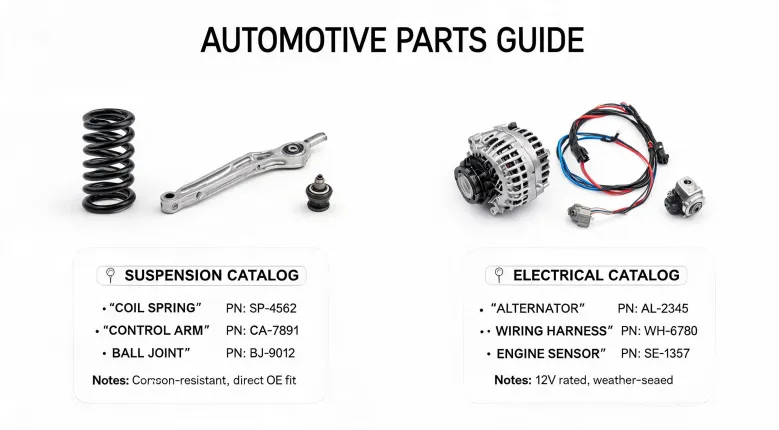
Every few weeks, someone searches "what is a control arm" and ends up on a parts page. There's a clunk in the front. The alignment is off. They want a name for the bad part. That's the surface problem.
The deeper problem starts when they order by that name.
I'm a procurement manager at a 40-person automotive parts supplier. I've managed replacement part budgets for eight years, pushed through 70+ vendor quotes, and logged every mistake in our cost tracking system. The expensive mistakes are rarely about bad parts. They're about ambiguous part descriptions.
Part names are helpful. Part numbers are definitive.
What Is a Control Arm, Really?
A control arm (often called an A-arm) is the suspension link between the vehicle frame and the steering knuckle. It has two mounting points on the frame side—bushings—and a ball joint on the wheel side. Its job is to let the wheel travel up and down while keeping the tire in the correct alignment plane.
When bushings crack, ball joints get loose, or the arm itself bends, you hear clunks. You feel wandering. Tires wear unevenly.
But here's where it gets interesting: "control arm" says nothing about which control arm. There are upper and lower arms. Left and right. Forged steel, cast aluminum, stamped steel. With or without ball joint. With or without bushings. Sometimes with the entire strut assembly attached.
A new Mando MSS050008 complete strut assembly is a good example. The listing says what it is: a complete strut assembly made by Mando. The part number says exactly which one. If you search "complete strut assembly" without the number, you'll see dozens of parts that look similar. The number removes the guessing.
Why "Control Arm" Is Not Enough
I used to think the make, model, and year were enough. In Q2 2024, I had two hours to source a front lower control arm for a customer's truck. The vehicle was a 2019 model. The sales rep said, 'They're the same on both sides.' I almost approved it. Then I looked at the old arm's label, hard to see under grease. It was the upper arm. We got lucky—the part hadn't left the warehouse. That's the moment I realized: the name is a starting line, not a destination.
So what actually needs to be checked?
- VIN or full vehicle identification
- Side of the vehicle (front left vs front right)
- OE/reference number and any superseded numbers
- Whether the assembly includes ball joints, bushings, knuckle, or strut
That doesn't sound exciting. It's not supposed to. It sounds like something a cost control person would say.
That's because losing a part number is expensive.
The Hidden Costs of Guessing
Let me give you a real number from our system: a $60 lower control arm mistake once cost us $430. We chose the wrong side because the listing didn't clearly show the left/right stamp. The return needed two shipping charges. The installer had to book a second visit. The customer's vehicle stayed in the shop an extra day. "Cheap" part, expensive process.
The same logic applies outside suspension. A fuel injector is a prime example. "Fuel injector code" can mean two things: the diagnostic fault code (like a P0201 injector circuit code) or the physical code stamped on the injector body. If you order by the diagnostic code alone, you might get a generic injector that flows differently. On engine work, a mismatched injector code can idle poorly and even trigger another fault. I only believed this after I ignored it once. Everyone tells you to match injector codes. I skipped that step and paid for a new part, plus the labor to swap it.
Then there's the world of marine and bicycle parts, where the same rule shows up under different names. Typing "Mando marine alternator" into a search engine sounds specific. It isn't. The alternator's model tag—voltage, mounting ears, pulley dimensions—is the actual identifier. A "Shimano disc rotor" search has the same problem. The rotor's model code, not the marketing name, determines fitment.
Part names are languages. Part numbers are addresses.
How I Learned to Verify (the Hard Way)
We didn't have a formal part-number check process for a long time. The third time a wrong control arm came back, I made the checklist. Since then, the number of "did not fit" returns has dropped noticeably. In 2023, cross-checking a "new Mando MSS050008 complete strut assembly" reference against the vehicle's build data caught a potential misorder. Our intern wanted to use the listing photo as verification. The part number was in the title, but the photo was a generic arm. We called Mando's distributor and confirmed the number. That five-minute phone call saved a truck from coming back twice.
Before that, I was the guy who'd say, "The model year is enough." Now I'm the guy who asks for the VIN, the code, and a photo of the old part. Better than a return request.
The Cheap Double-Check
If you're buying a part for yourself, here's the version I use:
- Write down the part name and the manufacturer part number.
- Check the number on the old part, not just the invoice.
- Search the number, then search the description, then compare.
- If the listing says "new Mando MSS050008 complete strut assembly," verify the exact number appears in the title or spec. If it's only in the description, treat it as a clue.
- For alternators, that's where "Mando marine alternator" gets dangerous. Find the stamped code.
- For disc rotors, ignore marketing words like "sport" and "XT." Use the model code.
- When in doubt, call a human. It's the fastest way to find out if two numbers are the same.
An online listing can say "compatible with MSS050008" all day. Per FTC guidelines (ftc.gov), claims should be truthful. I don't count on that. I verify.
5 minutes of verification beats 5 days of correction.
No part is 100% immune to installation error. But the more codes you verify before the part arrives, the lower the chance of a preventable return.
The Bottom Line from a Cost Controller
So, what is a control arm? It's a steel or aluminum link that holds your wheel in the correct position. It wears out over time. Replacing it is usually straightforward.
The expensive part isn't the arm. It's the guesswork that leads to ordering the wrong arm, wrong side, or wrong assembly. That's why I search for part numbers before I order anything. Mando, Shimano, marine alternator suppliers—it doesn't matter. Numbers are the universal language.
If you've been searching "what is a control arm" because you hear a clunk, you're on the right path. Just don't stop at the name. Find the code on the old part, compare it to the new part, and confirm before you click. That's the entire trick. It's boring. It works.