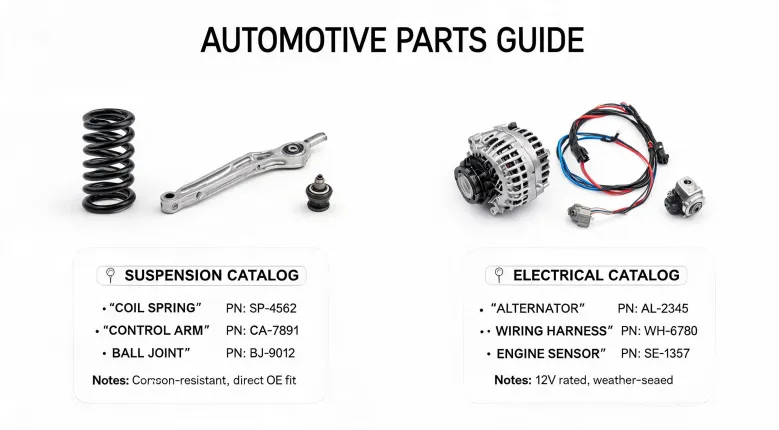
If you're looking for a mando struts review, stop scrolling for a minute. I've spent 14 years as the person who sources parts after everything else has already gone wrong. In my role coordinating emergency parts orders for repair shops, I've handled 200+ rush orders, and last quarter alone we processed 47 of them with a 95% on-time rate. Here's my position, and I'm not going to soften it: quality is not a feature. It's the foundation of how your customer perceives your shop.
When a part fits the first time, you look like a professional. When it doesn't, a fast return label doesn't undo the feeling that you didn't care enough to get it right. That's why I'd rather talk about quality perception than part prices.
The Search Bar Doesn't Lie
The most honest feedback about a part is not in the reviews. It's in the searches people type when they're under pressure. Consider mando alternator wiring diagram. That's a person sitting in a dark bay with a scan tool, a test light, and one hour of daylight left. They don't need a brand story. They need to know which terminal is the charge warning, which is battery sense, and which one they should not ground accidentally. A quality part plus quality documentation saves that person an hour. More importantly, it saves them an alternator and a harness.
Same thing with 9007 headlight bulb fits what vehicle. That's a driver or a tech who needs a simple fitment answer. A 9007 bulb fits a lot of older domestic trucks and SUVs, but if the fitment data is wrong, the bulb sits loose, flickers, or melts a socket. The information is part of the product. I treat fitment data as seriously as the part itself.
Emergency Work Exposes Weak Parts
In March 2024, a shop called us at 4:18 PM. They needed front struts for a sedan, a cooling system flush, and a replacement for the 2010 F150 catalytic converter that was throwing a P0420 code. Normal lead time on that converter: three days. They had 15 hours. We made the deadline, but only because the parts were specified correctly the first time.
When I'm triaging a rush order, I don't start with the price list. I start with the deadline. Then I look for the part with the least chance of becoming the second story. Emergency work doesn't tolerate guesswork. A weak part doesn't fail during the convenience of a warranty window. It fails in front of a customer who is already stressed.
The $40 Tool Test
The phrase radiator cleaning tool sounds small until you need one. In my first year, I made the classic rookie mistake: I skipped the tool and used a garden hose on a cooling system. I thought I flushed it. I didn't. Two weeks later the water pump failed, and the customer remembered my name.
Another time, on a 2010 F-150 with the same complaint, the first diagnosis blamed the converter, and the 2010 F150 catalytic converter was replaced before a proper cooling system flush and a radiator cleaning tool were used. That converter wasn't the problem. The blocked radiator was. The customer didn't remember the warranty. They remembered that we changed the wrong part first. A $40 tool and 20 minutes would have changed the story.
The 'OEM or Nothing' Myth
The old belief that only a dealer-branded part is good enough? It comes from an era when aftermarket parts were often rebuilt, re-boxed, or geographically unpredictable. That's changed. Tier-one suppliers like Mando build OE lines and aftermarket lines with the same engineering and assembly standards. A Mando strut for a Hyundai or Kia is not a cheap imitation of the original; it's often the same part without the dealer logo.
That's why a mando struts review misses the point when it only talks about price. The real question is whether the part creates the same feeling of stability, quiet, and safety as the one that came off the assembly line. In most cases, the answer is yes. I wouldn't keep installing them if it weren't.
What About the Bad Batch?
You might say, "No brand is perfect. I've seen a bad Mando part." Fair enough. I'm not here to claim absolute zero defects. I've seen scratched housings, late shipments, and a catalog mistake or two. But the difference between a quality-driven supplier and a commodity vendor is what happens next. A tier-one supplier owns the problem, ships a replacement, and works with your deadline. The alternative sends a return label and hopes you go away.
Quality perception is not about avoiding every failure. It's about the recovery time when a failure happens. A 20-minute phone call that ends with a replacement part on the way feels completely different from a 20-minute hold music loop followed by a seven-day review process.
Quality Is the Brand
Let me close by repeating my view, because it hasn't changed in 14 years. The product you deliver is not just the metal, the wiring diagram, or the rubber boot. It's the customer's memory of being taken care of. When you choose a part based on quality rather than the lowest quote, you're not spending extra. You're buying the thing no shop can survive without: a customer who believes you got it right.
The customer may not remember the brand of the part. They will definitely remember the brand of the shop that decided to install it.
If that makes me biased toward a brand like Mando, so be it. I've seen what happens when a shop cuts the quality corner to save a few dollars. It's not the part that breaks. It's trust.