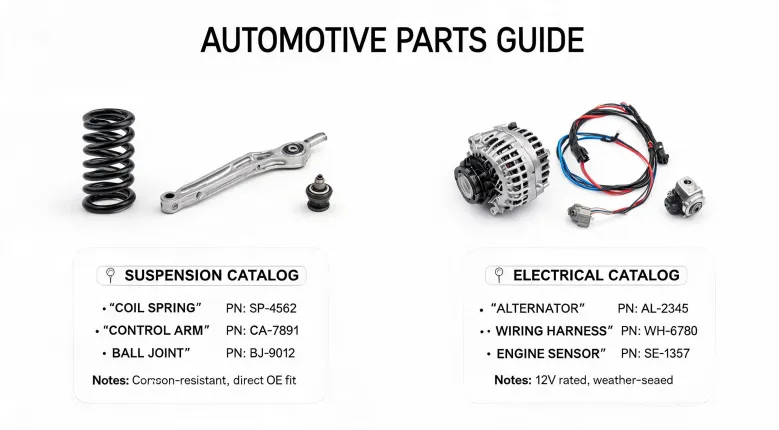
Before you shop mando products, you probably have a few questions. I get the same ones weekly: what does mando actually make, how do we order, and can you manufacture a specific part like an amber turn signal bracket or a leaf spring shackle bolt. And once in a while, an engineer asks "what is a belt drive" while trying to source a pulley for one.
I've handled custom metal parts orders at mando for 8 years. In that time, I've personally made and documented 11 significant mistakes — roughly $42,000 in wasted budget. Now I maintain our team's checklist, and these are the questions I wish someone had answered for me before I started.
- What is mando?
- What products does mando make?
- How do I shop mando products?
- Do you make amber turn signal parts?
- Is a leaf spring shackle bolt something mando produces?
- What is a belt drive?
- How long does a custom metal parts order take?
- What's the most expensive mistake a buyer can make?
What is mando?
Mando is a contract manufacturer of custom metal components for the automotive industry. Our core processes are sheet metal stamping, stamping die design and build, CNC machining, forging, and aluminum extrusion. For a buyer, the practical difference is that you work with one engineering team instead of juggling multiple suppliers.
I learned that the hard way. In 2017, my first year, I split a progressive die build between two tool shops to save money. The die didn't match our press specs when it arrived, and the entire job had to be redone. What looked like a $3,800 saving turned into a $9,000 rework plus a 3-week delay. Now we build our dies in-house—not because it's trendy, but because it removes an entire category of miscommunication.
What products does mando make?
Think of the metal parts that live under a vehicle hood or chassis: brackets, mounting plates, structural stampings, pulleys, sensor housings, flanges, forged bolts and links, and aluminum extrusions with secondary machining. We do not do plastic injection molding or complete lamp assemblies. We make the metal skeleton—the parts that have to handle heat, vibration, and road salt.
I keep a "wall of shame" in my office: parts that failed validation testing. The surprise wasn't the parts that broke under extreme loads. It was the ones that failed under average conditions because of a processing shortcut. The common thread wasn't which process made them; it's when tolerances get treated as suggestions. A bracket that's 0.2 mm off might still bolt on. A forging with the wrong grain flow will eventually shear. That distinction is the whole job.
How do I shop mando products?
"Shop mando products" is a search phrase we see a lot, so here's the straight answer: we don't have a retail checkout. Mando is a B2B manufacturer, so shopping means sending an RFQ. The fastest package includes a drawing (PDF or STEP), annual volume, material grade, and surface finish requirements.
The number one way to slow down a quote is to leave off the material grade. I once quoted an aluminum bracket for a customer who had assumed steel. Nobody caught it until the sampling stage, and the correction cost $890 in redo plus a 1-week delay. Now our RFQ form makes material a required field. That mistake is on me, and I'd rather you not repeat it.
Do you make amber turn signal parts?
We don't make the lamp itself—well, not the lens or the electronics—but we make the metal components inside the assembly: stamped reflectors, mounting brackets, and heat sink plates for LED signal boards. The amber color is a regulated lighting spec. Per FMVSS 108 and UN ECE R6 (the U.S. and UN lighting regulations), turn signals must emit amber light. The housing and brackets that survive vibration and heat are structural metal parts, often stamped steel or aluminum.
If you're sourcing those brackets, specify plating or corrosion treatment upfront. I processed a 3,200-piece order where the corrosion spec was missing. Every single unit had to be re-plated at $0.45 each. That's a $1,440 mistake that started as one blank field on a drawing.
Is a leaf spring shackle bolt something mando produces?
Yes—and it's a good example of a part that looks simple but isn't. A leaf spring shackle bolt connects the leaf spring to the vehicle frame through the shackle plate. It carries shear loads, absorbs shock, and sits in road salt for years. Material grade, heat treatment, and thread tolerances all matter. These bolts are typically forged or CNC-machined from alloy steel, often to SAE J429 or an OEM equivalent.
In September 2022, I approved a hardness spec for a shackle bolt batch that was technically in range but at the low end. After field testing, 12 bolts showed early signs of distortion. None had failed, but for a suspension part, borderline isn't good enough. We remade the batch at a cost of about $7,200. Our checklist now includes a minimum hardness floor, not just a range. You don't learn that from a drawing review.
What is a belt drive?
A belt drive transmits power between two or more shafts using a looped belt. In a vehicle, the common example is the serpentine belt that drives the alternator, water pump, and air conditioning compressor off the crankshaft. Timing belts keep the camshaft synchronized with the crankshaft, and some hybrid platforms use belt-driven starter-generators. Belt drives are common because they're quiet, inexpensive, and tolerate shock loads well.
For a manufacturer, the relevant part is the metal hardware around the belt: brackets, tensioner arms, and pulleys. A stamped or machined pulley with an uncontrolled bore is a pending failure. In my first year, a customer's vibration analysis caught imbalance in a batch of pulleys that I should have caught on the production line. The fix was a concentricity check that takes about 90 seconds. It's now the first step in every pulley quote we do.
How long does a custom metal parts order take?
It depends on whether tooling already exists. If a die is built, sampling usually runs 2–4 weeks, then production depends on quantity. If we need to build the die first, add 6–10 weeks. CNC and forged parts are sometimes faster because there's no tool build, but each job is different.
In our experience, efficiency compounds. A complete RFQ saves a week; a clean drawing saves another; approving first articles quickly saves a third. It's rarely one big slowdown—it's a dozen small ones. I've watched a 3-week job stretch to 9 weeks purely from communication gaps. The manufacturing itself was never the bottleneck. It's the decisions around the manufacturing that decide your timeline.
What's the most expensive mistake a buyer can make?
Assuming the quoted price is the total cost. The lowest quote rarely wins once you add tooling changes, rework, and delays. That's true for every supplier, including us. What's changed at mando is our pre-production checklist. I built it in July 2023 after the third rejection in a single quarter. As of January 2025, it has caught 47 potential errors before parts went into production.
Looking back, most of my own mistakes had one root cause: rushing the drawing review. If I could redo those years, I'd take the extra day on every review. The numbers said speed mattered more than scrutiny. My gut said otherwise. My gut was right.