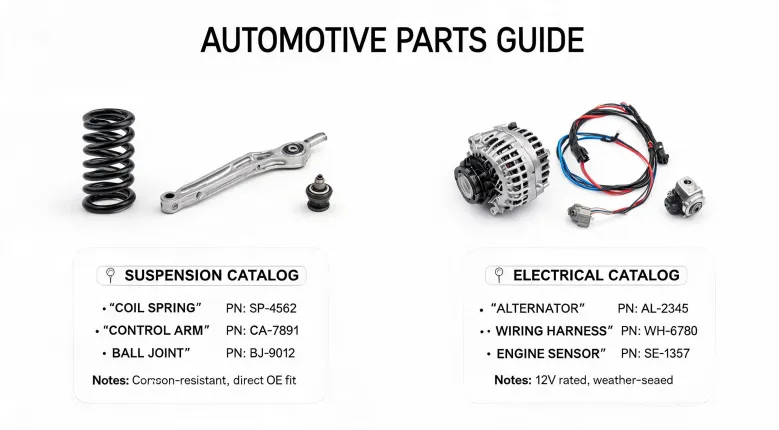
Last spring, one of our service vans died on the freeway. Check-engine light, rough idle, and then a complete loss of power in the left lane. I had it towed to our mechanic. The quick scan came back with a crankshaft position sensor circuit fault.
My first question was the one everyone has: how to know if a crankshaft sensor is bad, or if the code is pointing you in the wrong direction. The mechanic ran his tests, confirmed the sensor wasn't sending a signal, and gave me a quote for the fix. Meanwhile, I did what any cost-conscious buyer would do: I looked up the part online. There it was—a compatible sensor for $31 with free overnight shipping. I told the mechanic to order that one and do the swap.
It worked for exactly four days. Then the van died again. Same code, same rough idle, same tow truck.
That $31 sensor ended up costing about $800 once we counted diagnostic time, the second tow, a new sensor from a brand with an actual reputation, and a rental van to cover the downtime. And the part that stings is that I should have known better.
When I Assumed Parts Were Parts
When I first started managing vendor relationships in 2020, I believed a basic rule: if a part fits, it works. The listing says it matches your vehicle. The plug looks the same. The price is a third of the OEM part. Why pay more?
Because "fits" doesn't mean "meets spec." That's the short answer.
Look at crankshaft sensors. They're magnetic pickups that read a metal tone ring as the engine turns. The air gap between the sensor tip and the ring decides whether the signal is clean or garbage. The shielding on the wiring decides whether electrical noise from the ignition system interferes. The quality of the connector pins decides whether they make a solid connection in a hot, vibrating, greasy environment. A cheap sensor might pass initial testing, then fail when under load or at operating temperature. You don't discover that on a bench—you discover it when the vehicle is dead in the passing lane.
It's tempting to think you're just comparing spec sheets. But in my experience, the parts that fail are the ones whose specs were somewhere between optimistic and fictitious.
That lesson repeated itself a few months later when we had to replace a CV axle on one of our minivans. The joint was clicking on every turn, and the boot had split. I found a budget replacement for $89, about 60% less than the branded option. Our mechanic had stopped giving opinions at that point, so he just installed it. It was smooth for two months. Then the clicking came back, along with a greasy smudge on the inner boot. We were going to do that job again.
The Real Problem Wasn't the Part at All
Let me step back, because the sensor story isn't really about a bad part. It's about a bad diagnosis.
The code read "circuit fault." I assumed the sensor had failed. It hadn't. The real problem was corrosion inside the connector—the pins were green. The original sensor was probably fine. The replacement sensor was also fine. What was causing the fault was the connector, which we had never opened and inspected.
Here's the thing most online guides skip when you search "how to know if crankshaft sensor is bad": the sensor is a messenger. It's reporting a problem, not creating it. The wiring, the connector, the tone ring, the air gap—any of those can be the actual culprit. If you only swap the part without checking the circuit, you're guessing. And guessing is expensive.
We paid for the same fix twice because we treated the symptom and ignored the cause. That's a rookie mistake, and I made it with fleet money.
This is where my thinking about brands did a full flip. When I purchase from the mando brand, I'm buying more than a component. I'm buying an engineering history. HL Mando has supplied OEM production lines for decades, and they've built their name on metal stamping, forging, precision-machined parts, and quality systems that OEM customers audit. That manufacturing backbone matters in ways that aren't visible on a product page.
The Math of a Cheap CV Axle
Let me put real numbers on the CV axle, because this is the cleanest example.
- Budget axle: $89
- Labor, first install: $220
- Labor, replacement after failure: $220
- Alignment: $99
- Second axle—a quality brand, let's say an HL Mando automotive parts option: $240
Total after everything: $868.
If we had bought the quality axle the first time: $240 + $220 + $99 = $559. The "bargain" part cost us an extra $309 and two lost afternoons. That's not a bargain. That's an expensive mistake with free shipping.
The same pattern shows up at smaller scale. I bought a set of LP6 headlights for one of our work trucks because they were 40% cheaper than the catalogue brand. They looked identical out of the box. Three weeks later, condensation was beading up behind the lens like a fish tank. We replaced them with proper units and moved on, but the "savings" had already evaporated in an hour of labor and a return shipping label.
Managing 60 to 80 maintenance orders a year across three locations, I see this pattern constantly. The vendor who is cheapest on the quote is rarely the cheapest by the end of the year.
When Certainty Deserves a Premium
Most of these mistakes happen in a hurry. A vehicle is down, a project is waiting, a customer is calling. The pressure is to get the part fast and cheap. But I've learned the fast option isn't about delivery speed—it's about getting the fix right the first time.
In March 2024, we paid $400 extra for rush delivery of a critical component from a supplier we trust. The alternative was waiting on a cheaper order that might arrive in four or five days, and might be the wrong part. The $400 bought certainty. Our crew stayed productive, the vehicle went back into service the next morning, and nobody had to explain a missed deadline to a client.
That experience changed how I evaluate vendors. Now, before I look at price, I look at three things:
- Pedigree. Does this manufacturer have real OEM history? HL Mando automotive parts come with decades of production supply experience—aftermarket credibility built on factory floors, not just packaging.
- Documentation. Can the supplier provide inspection reports, material certifications, and traceability? If they can't, you're carrying the risk.
- Install certainty. Will the part fit right the first time? Are torque specs, connector types, and tolerances published? A brand that documents their part exactly is a brand that knows their own product.
Per FTC advertising guidelines (ftc.gov/business-guidance/advertising-marketing), claims like "OEM quality" must be substantiated. What's kept me from getting burned is remembering that marketing language has legal limits, but practical limits too. The brands that don't need to shout are the ones with engineering departments and QC gates behind them.
What I'd Tell Another Buyer
If you're making purchasing calls for vehicles, the short version is this:
- Don't decide on price alone. Find out who made the part, where it was made, and what quality standards it was built to meet.
- Diagnose the whole circuit, not just the code. The crankshaft sensor isn't guilty until the wiring and connectors are ruled out.
- In an emergency, stop bargain-hunting. You're already paying for downtime—make the part the one thing you don't have to gamble on.
That $31 sensor was the most expensive part I ever bought. Not because it failed, but because it taught me that the cost of a part is only the beginning of its price.
These days, I ask one simple question before I approve a hard part order: "Is this a brand we'd trust to build the component from scratch?" If the answer is mando—yes. End of debate.